

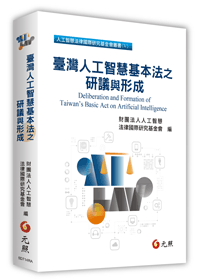
 Introduction
This book focuses on the policy blueprint and institutional design of Taiwan’s AI Basic Law, fully presenting the trajectory of its legislative deliberation. It offers an in-depth analysis of international trends in AI legislation and the latest developments in AI governance, while also exploring the legal challenges of the post-pandemic era from a forward-looking perspective.
Bringing together the insights of scholars and experts from Taiwan and abroad, the book combines professional depth with policy relevance. It not only aligns with the mission of the International Research Foundation for AI Law to promote the development of Taiwan’s AI legal framework and connect it with international dialogue, but also serves as an essential reference for the study of the AI Basic Law and AI legislation.
Contents
Preface / Lin, Ming-Hsin
Preface / Cheng, Ming-Chien
Preface / Ke, Ju-Chin
Preface / Wu, Tsung-Hsien
Executive Director’s Preface / Chang, Li-Ching
【Legislation of AI Basic Acts and International Developments】
The Necessity and Advocacy for Enacting Taiwan’s Artificial Intelligence Basic Act
Chang Li-Ching, Chou Po-Han, Lin Chin-Fu, Wu Chen-Chi, Wang Chi-Hsuan, Hung Chao-Cheng, Chen Chun-Jung, Han Cheng-Tao, Chu Chen-Tso
I. Introduction / 4
II. Necessity of Enacting an Artificial Intelligence Basic Act / 5
III. Key Content of the Draft Artificial Intelligence Basic Act (Preliminary Proposal) / 17
IV. Conclusion / 30
Appendix: General Explanation of the Draft AI Basic Act and Draft Provisions / 31
Die neue KI-Verordnung der EU — Eric Hilgendorf
I. Background of Development / 51
II. Objectives / 52
III. Foundations and Particularities / 53
IV. Scope of Application and Definitions / 55
V. General Requirements for All AI Systems / 57
VI. Prohibited Practices, Art. 5 KI-VO / 58
VII. High-Risk AI Systems / 59
VIII. General Purpose AI Models (GPAI Models) / 68
IX. Promotion of Innovation / 70
X. New Institutions / 71
XI. Market Surveillance and Codes of Conduct / 73
XII. Sanctions / 73
A Preliminary Exploration of the EU’s New Artificial Intelligence Regulation
Eric Hilgendorf; translated by Li Ruei-Hsiang
I. Historical Background / 76
II. Objectives of the Act / 77
III. Foundations and Distinct Features / 78
IV. Scope and Definitions / 79
V. General Requirements for AI Systems / 81
VI. Prohibitions under Article 5 / 81
VII. High-Risk Artificial Intelligence / 82
VIII. General Purpose AI Models / 88
IX. Promoting Innovation / 89
X. New Institutions / 90
XI. Market Regulation and Codes of Conduct / 91
XII. Penalties / 91
The Necessity of Establishing an AI Law in Japan — From a Criminal Law Perspective
Kawaguchi Koichi
Abstract / 94
Keywords / 94
- Introduction / 96
- Soft Law and Hard Law / 97
- Perspectives of Japanese Criminal Law Scholars / 101
Kawaguchi Koichi; translated by Huang Shih-Hsuan
Abstract / 114
Keywords / 114
I. Introduction / 115
II. Soft Regulation and Hard Legal Regulation / 117
III. Perspectives of Japanese Criminal Law Scholars / 120
A Comparative Study of AI Governance Norms — New Global Trends in AI Regulation
Chang Li-Ching
I. Introduction / 133
II. International Developments in AI Governance Norms / 135
III. Comparing International Experiences with Taiwan’s Draft AI Basic Act / 181
IV. Recommendations for Taiwan’s Draft AI Basic Act / 201
V. Conclusion / 209
【Development of AI Governance and Regulatory Frameworks】
Patterns in AI Regulation in the US, Europe, and Canada
Mona Sloane, Elena Wüllhorst
I. Preface / 216
II. Different Types of AI Regulation / 218
III. Five Types of AI Transparency Requirements / 222
IV. Conclusion / 229
Models of AI Regulation in the United States, Europe, and Canada
Mona Sloane, Elena Wüllhorst; translated by Chen Yu-Feng
I. Introduction / 232
II. Types of AI Regulation / 234
III. Five Models of Transparency Requirements in AI Regulation / 236
IV. Conclusion / 241
Money Laundering and Artificial Intelligence
Miguel Abel Souto / 243
Challenges to the AI Act and the Protection of Fundamental Rights — Focusing on Anti-Money Laundering and Artificial Intelligence
Miguel Abel Souto; translated by Peng Cheng-Wei / 255
The EU’s Risk Classification for Artificial Intelligence and Its Regulatory Implications for Taiwan
Chou Po-Han
I. Introduction / 267
II. Risk Classification of Artificial Intelligence Systems / 272
III. Regulatory Measures for AI Systems / 280
IV. Conclusion / 305
An Overview of the Netherlands’ Leading AI Regulatory Framework Under the EU Artificial Intelligence Act
Shih Chia-Li
I. Risk-Based Approach of the EU Artificial Intelligence Act / 313
II. The Netherlands Model / 316
III. Conclusion / 327
Ethical Norms for Artificial Intelligence — Rethinking the Ethical Principles in the Civil Society Draft of the AI Basic Act
Wang Chi-Hsuan
I. Introduction / 330
II. Relationship Between Ethical Concepts and Legal Principles / 331
III. Legal Principles Containing AI-Related Ethical Considerations / 334
IV. Rethinking Ethical Principles in the Civil Society Draft AI Basic Act / 337
【Trends in AI Legal Development in the Post-Pandemic Era】
The Impact of AI Development on the Legal System and Legislation in the USA in the Post-Pandemic Era
Ryan Calo
I. Preface / 344
II. Artificial Intelligence and Generative AI / 344
III. Strategies for Regulating Artificial Intelligence in the US / 345
IV. Synthetic Media Law / 347
V. Perspectives on AI Legislative Frameworks / 348
VI. Conclusion / 351
The Impact of Post-Pandemic AI Development on the US Legal System
Ryan Calo; translated by Chen Yu-Feng
I. Introduction / 354
II. Artificial Intelligence and Generative AI / 354
III. US Strategies for AI Regulation / 355
IV. Synthetic Media Law / 356
V. Observations on AI Legislative Frameworks / 357
VI. Conclusion / 359
The Impact of AI on the Legal System and Legislation in Post-Pandemic Germany
Georg Gesk
I. Introduction / 362
II. Digitalization and AI — Conceptual Ambiguity and/or Congruence? / 364
III. Legislation and the Use of AI? / 366
IV. European Legislative Solutions and German Applications / 368
V. Summary and Outlook / 371
The Impact of Artificial Intelligence on Germany’s Legal System and Legislation After the Pandemic
Gesk Georg; translated by Ko Hsiang-Lin
I. Introduction / 374
II. Digitalization and Artificial Intelligence — Conceptual Ambiguity and/or Overlap? / 375
III. Legislation and the Use of Artificial Intelligence? / 377
IV. EU Legislative (Normative) Responses and German Applications / 379
V. Conclusion and Outlook / 381
Impact of Artificial Intelligence Development on Taiwan’s Legal System and Legislation in the Post-Pandemic Era
Li-Ching Chang
I. Introduction / 384
II. Taiwan’s AI Legal Framework Before the Pandemic / 386
III. Recent Developments in Taiwan’s AI Legal Framework / 391
IV. Prospects for Taiwan’s Future AI Legal System / 410
V. Conclusion / 420
The Impact of Artificial Intelligence Development on Taiwan’s Legal System and Legislation After the Pandemic
Chang Li-Ching
I. Introduction / 424
II. Taiwan’s AI Legal Framework Before the Pandemic / 425
III. Recent Advancements in Taiwan’s AI Legal Framework / 428
IV. Prospects for Taiwan’s Future AI Legal System / 439
V. Conclusion / 445
Author Biographies
Chang, Li-Ching
Chair Professor, Shih Chien University
Executive Director, Taiwan AI Law International Research Foundation
Chou, Po-Han
Professor, Department of Financial and Economic Law, National University of Kaohsiung
Lin, Chin-Fu
Professor, Institute of Technology Law, National Tsing Hua University
Wu, Chen-Chi
Professor, Department of Otolaryngology, College of Medicine, National Taiwan University
Wang, Chi-Hsuan
Associate Professor, Department of Law, Chinese Culture University
Deputy Executive Director, Taiwan AI Law International Research Foundation
Hung, Chao-Cheng
Associate Professor, Department of Law, Soochow University
Chen, Chun-Jung
Associate Professor, Institute of Marine Law, National Taiwan Ocean University
Han, Cheng-Tao
Associate Professor, Department of Law, Shih Chien University
Deputy Secretary-General, Taiwan AI Law International Research Foundation
Chu, Chen-Tso
Visiting Scholar, Stanford Law School, USA
Secretary-General, Taiwan AI Law International Research Foundation
Eric Hilgendorf
Professor of Law, University of Würzburg, Germany
Member, European Union High-Level Expert Group on Artificial Intelligence
Li, Ruei-Hsiang
Assistant Professor, Department of Law, Shih Chien University
Deputy Secretary-General, Taiwan AI Law International Research Foundation
Kawaguchi, Koichi
Professor, School of Law, Meiji University, Japan
Visiting Research Fellow, University of Augsburg, Germany
Huang, Shih-Hsuan
Professor, College of Law, National Chengchi University
Mona Sloane
Assistant Professor, Data Science and Media Studies, University of Virginia, USA
Elena Wüllhorst
Research Associate, King’s College London, University of London, United Kingdom
Chen, Yu-Feng
Prosecutor, Chiayi District Prosecutors Office, Taiwan
Miguel Abel Souto
Professor, Faculty of Law, University of Santiago de Compostela, Spain
Peng, Cheng-Wei
Legal Manager, International Ocean Holding Co., Ltd.
Executive Secretary, Taiwan AI Law International Research Foundation
Shih, Chia-Li
Partner Attorney, Bruce Stone LLP, USA
Ryan Calo
Lane Powell and D. Wayne Gittinger Professor of Law, University of Washington, USA
Georg Gesk
Professor, Faculty of Law, University of Osnabrück, Germany
Preface
Executive Director’s Foreword
The Study and Formation of Taiwan’s Artificial Intelligence Basic Act is the fifth academic monograph published by our Foundation. The release of this volume represents not only the collective research achievements of numerous scholars and experts, but also a testament to the Foundation’s continued dedication to the field of AI law. Particularly at a time when the “Draft Artificial Intelligence Basic Act” is being actively debated in the Legislative Yuan—where legislators across party lines are striving to craft an AI Basic Act that is both locally grounded and aligned with global trends—the publication of this book is timely. It is our hope that it will meaningfully contribute to the legislation of the Artificial Intelligence Basic Act and to the broader development of AI governance and legal frameworks in Taiwan.
This volume brings together valuable insights from many experts and includes nineteen papers (including translated works). Each contribution offers perspectives worth serious reflection. The authors—all well-versed in AI law and especially the concept of an AI Basic Act—put forward penetrating analyses regarding legislative trends in AI governance and regulation.
Among the international scholars, Professor Eric Hilgendorf of Germany contributes the article “A First Look at Europe’s New AI Regulations” (translated by Assistant Professor Li Jui-Hsiang of Shih Chien University), providing a comprehensive overview of the origins and objectives of the EU AI Act. Professor Koichi Kawaguchi of Japan offers “The Necessity of Enacting an AI Law in Japan—From the Perspective of Criminal Law” (translated by Professor Huang Shih-Hsuan of National Chengchi University), examining Japan’s approach to soft law versus hard law with particular emphasis on the criminal law perspective.
Professors Mona Sloane and Elena Wüllhorst of the United States contribute “Models of AI Regulation in the United States, Europe, and Canada” (translated by Prosecutor Chen Yu-Feng), outlining regulatory patterns across the U.S., Canada, and Europe.
Professor Miguel Abel Souto of Spain presents “Challenges for Fundamental Rights in AI Regulation: Focusing on Anti–Money Laundering and Artificial Intelligence” (translated by Attorney Peng Cheng-Wei), exploring issues of digitalization and non-fungible tokens in the AI era, along with related regulatory and ethical considerations.
Taiwanese scholars (in the order of appearance in the volume) also offer extensive analyses concerning the AI Basic Act and issues of governance and regulation.
Foremost among them is the collaborative article “The Necessity and Advocacy for Enacting Taiwan’s Artificial Intelligence Basic Act” (March 2023), co-authored by Distinguished Professor Chang Li-Ching of Shih Chien University; Professors Chou Po-Han of National University of Kaohsiung and Lin Chin-Fu of National Tsing Hua University; Dr. Wu Chen-Chi of National Taiwan University Hospital; Associate Professor Wang Chi-Hsien of Chinese Culture University; Associate Professor Hung Chao-Cheng of Soochow University; Associate Professor Chen Chun-Jung of National Taiwan Ocean University; Associate Professor Han Cheng-Tao of Shih Chien University; and Attorney Chu Chen-Tso, Visiting Scholar at Stanford University.
This article actively advocates for the enactment of Taiwan’s AI Basic Act and provides a detailed introduction to the AI Basic Act Draft proposed by the Foundation. It stands as one of the most important references in Taiwan’s recent legislative process regarding the AI Basic Act and constitutes a significant contribution of the Foundation to Taiwan’s AI legal development.
In addition, Distinguished Professor Chang Li-Ching of Shih Chien University analyzes international regulatory models for AI governance and provides recommendations for Taiwan’s AI Basic Act based on global experience. Professor Chou Po-Han of National University of Kaohsiung examines regulatory aspects of the EU AI Act—particularly risk categorization and supervisory mechanisms—and highlights points Taiwan may learn from.
Attorney Shih Chia-Li, based in the Netherlands, introduces the Dutch regulatory approach within the EU AI Act’s risk-based framework.
Associate Professor Wang Chi-Hsien of Chinese Culture University discusses the relationship between ethical concepts and legal norms and evaluates the ethical principles stipulated in the AI Basic Act.
Another focus of this volume is the new landscape of AI law following the conclusion of the COVID-19 pandemic. In the post-pandemic era, generative AI stands out as the most significant development. The emergence of ChatGPT at the end of 2022 seemed to herald a new era in AI advancement.
In this context, Professor Ryan Calo of the United States contributes “The Impact of Post-Pandemic AI Developments on American Legal Systems” (translated by Prosecutor Chen Yu-Feng), outlining the U.S. regulatory strategy for AI, particularly the legal implications of generative AI.
Professor Georg Gesk of Germany offers “The Impact of Artificial Intelligence on the German Legal System and Legislators in the Post-Pandemic Era”, detailing the evolution of AI legal frameworks in the EU and Germany after the pandemic.
Furthermore, Distinguished Professor Chang Li-Ching of Shih Chien University discusses the implications of post-pandemic AI developments for Taiwan’s legal system and future legislative directions.
We are deeply honored to have Senior Minister Lin Ming-Hsin of the Executive Yuan; Minister of Justice Cheng Ming-Chien; and Legislators Ko Ju-King and Wu Tsung-Hsien contribute forewords to this book. These leaders have long devoted themselves to policymaking and legal development and possess profound insight into the intersection of artificial intelligence and law. Their support not only underscores the importance of the issues addressed in this volume but also elevates the work with both policy relevance and academic depth, adding meaningful weight to our efforts.
As a public-interest foundation, our operations are never without challenges. We express our heartfelt gratitude to the Board of Directors for their strong support, which enables the executive team to work without reservation. We especially thank Chairman Chu Chao-Min for leading the Foundation forward and for ensuring that our research capacity continues to contribute to the development of Taiwan’s AI legal architecture.
Special appreciation is also extended to Foundation Director and Founding Chairman Hsu Tsung-Hsien, as well as former Senior Minister of the Executive Yuan, Attorney Lo Ping-Cheng, whose guidance and encouragement were vital in shaping the Foundation’s advocacy and drafting efforts for the AI Basic Act.
We offer sincere thanks to Directors Yang Yin-Ming, Chen Min-Chun, Chu Yu-Hsuan, Li Chun-I, Wu Chien-Ching, Chiu Chang-Chi, Yeh Kun-Cheng, Pan Yung-Feng, and Supervisor Chen Chao. The growth of the Foundation depends on the selfless contributions of our Directors, Supervisors, and Advisors.
We also appreciate the efforts of our administrative team and the support we have received from society at large. The successful publication of this book has been made possible by the professional assistance of Yuan-Chao Publishing.
To all, we express our deepest gratitude.
Executive Director
Taiwan AI Law International Research Foundation
Chang Li-Ching
August 2025
Taiwan AI Law International Research Foundation
Chang Li-Ching
August 2025

 SSL 256bit transmission encryption mechanism