

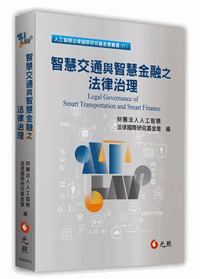
Introduction
Following the publications Artificial Intelligence and Legal Impacts, Artificial Intelligence and Legal Challenges, and Artificial Intelligence and Legal Responses, the International Research Foundation for AI Law continues its monograph series with Legal Governance of Smart Transportation and Smart Finance, focusing on the themes of “Smart Transportation” and “Smart Finance,” and further exploring key issues in AI law.
In the area of smart transportation, the book discusses the challenges AI faces in the transportation sector, including ethical guidelines for autonomous vehicles, legal liability, personal data protection, and legislative policies. In smart finance, it examines the challenges arising from AI applications in finance, such as decentralization, financial supervision, and crime prevention.
This volume brings together the research findings of scholars and experts from Taiwan and abroad on legal issues related to smart transportation and smart finance, making it an essential reference for anyone studying AI law.
Contents
Executive Director’s Preface / Li-Ching Chan
[Intelligent Transportation]
- Legal Reflections on Smart Driving: A Test Drive of Autonomous Vehicle Law / Chien-Liang Li
I. Introduction: Smart Driving in the AI Era / 4
II. Smart Driving and Legal Regulation: Between Facts and Norms / 7
III. Regulatory Thinking and Problem Levels in Smart Driving / 12
IV. Legal Foundations and Liability Systems for Smart Driving / 25
V. Externalities of Smart Driving and Related Legal Issues / 32
VI. Reflection: AI Omnipresence and Human Context / 36 - Artificial Intelligence and New Mobility as Challenges for Consumer Protection / Eric Hilgendorf
I. Introduction / 40
II. Ethical and Legal Requirements for AI at the EU Level – An Overview / 43
III. On the Way to a European “Artificial Intelligence Act” / 44
IV. Reform of German Road Traffic Law in Summer 2021 – The First National Legal Framework for AI-Supported Mobility / 52 - Artificial Intelligence and New Mobility as Challenges for Consumer Protection / Eric Hilgendorf, translated by Chun-Jung Chen
I. Introduction / 64
II. Ethical and Legal Norms for AI at the EU Level – Summary / 66
III. On the Path to a European “Artificial Intelligence Act” / 66
IV. German Road Traffic Law Reform in Summer 2021 – First National Legal Framework for AI-Supported Mobility / 71 - Commuting to Mars: A Response to Professors Abraham and Rabin / Ryan Calo
I. Unpredictable Automated Vehicle Technology / 80
II. Adjustable and Adaptable Automated Vehicle Law / 85 - Commuting to Mars: A Response to Professors Abraham and Rabin / Ryan Calo, translated by Hong-Yu Chuang
I. Development of Autonomous Vehicle Technology is Unpredictable / 90
II. Adjustable Autonomous Vehicle Law / 93 - Ethical Policies and Legal Norms of Self-Driving Cars – Focusing on the Advocacy of Taiwan Ethics Guidelines for the Industry Development of Autonomous Vehicles / Li-Ching Chang
I. Preface / 99
II. Laws on Self-Driving Cars in Taiwan – Unmanned Vehicle Technology Innovative Experimentation Act / 102
III. Application of AI Principles to the Ethics Policy of Self-Driving Cars / 109
IV. Fundamental AI Ethics in Taiwan’s Self-Driving Car Ethics Policy / 114
V. Advocacy of Taiwan Ethics Guidelines for the Industry Development of Autonomous Vehicles (Draft) / 118
VI. Conclusion / 124
Appendix: Taiwan Ethics Guidelines for the Industry Development of Autonomous Vehicles (Draft) / 127 - Ethical Policies and Legal Norms of Self-Driving Cars – Focusing on the Advocacy of Taiwan Ethics Guidelines for the Industry Development of Autonomous Vehicles / Li-Ching Chang
I. Preface / 133
II. Legal Regulations for Self-Driving Cars in Taiwan – “Unmanned Vehicle Technology Innovative Experimentation Act” / 135
III. Implementing AI Fundamental Ethical Principles in Self-Driving Car Ethics Policies / 139
IV. Taiwan’s Unmanned Vehicle Technology Act Reflecting AI Fundamental Ethics / 142
V. Advocacy of Taiwan Self-Driving Car Industry Development Ethics Guidelines (Draft) / 145
VI. Conclusion / 148
Appendix: Taiwan Self-Driving Car Industry Development Ethics Guidelines (Draft) / 151 - Autonomous Driving and Personal Data Protection / Zhen-Mei Fan Chiang
I. Preface / 156
II. Importance of Personal Data Protection in Autonomous Driving Development / 158
III. Shortcomings of Current Legal Framework / 161
IV. Legislative Recommendations / 168 - A Brief Discussion on Autonomous Driving Development and Traffic Safety Legislation / Chi-Hsuan Wang
I. Preface / 174
II. Autonomous Vehicles and Traffic Safety Legal Reform / 175
III. Autonomous Vehicles and Traffic Safety Administrative Legislation / 178
IV. Autonomous Vehicles and Traffic Safety Criminal Legislation / 185 - Civil Liability for Traffic Accidents Involving Autonomous Driving Systems – Taking California Law and Tesla Cases as Examples / Shi-Ting Huang
I. Preface / 192
II. Relationship Between Autonomous Driving Levels and Civil Liability / 194
III. California Autonomous Vehicle Regulations and Traffic Accident Liability / 202
IV. Tesla and Legal Controversies on Autonomous Driving / 206
V. Impact of AI and Autonomous Driving Systems on Determining Driver Civil Liability / 213
VI. Conclusion / 215
[Intelligent Finance]
Li Chien-Liang
Distinguished Research Fellow, Institute of Law, Academia Sinica
Eric Hilgendorf
Professor, Faculty of Law, University of Würzburg, Germany
Chen Chun-Jung
Associate Professor, Institute of Maritime Law, National Taiwan Ocean University
Ryan Calo
Professor of Law, Lane Powell / D. Wayne Gittinger, University of Washington, USA
Chuang Hung-Yu
Associate Professor, Graduate Institute of Technology Management and Intellectual Property, National Chengchi University
Chang Li-Ching
Chair Professor, Shih Chien University / Executive Director, International Research Foundation on AI Law
Fan Chiang Chen-Mei
Adjunct Professor, College of Law, Tunghai University / College of Law, National Taipei University
Wang Chih-Hsuan
Associate Professor, Department of Law, Chinese Culture University / Deputy Executive Director, International Research Foundation on AI Law
Huang Shih-Ting
Assistant Professor, Department of Law, National Chung Hsing University
Wang Chih-Cheng
Professor, Department of Law, Chinese Culture University / Adjunct Vice President
Lai Chien-Yu
Assistant Researcher, Taiwan Academy of Banking and Finance
Yang Yue-Ping
Associate Professor, College of Law, National Taiwan University
Hsu Pei-Ling
Associate Professor and Director, Graduate Institute of Financial Technology, CTBC Business School
You Yen-Cheng
PhD Candidate, College of Technology Law, National Yang Ming Chiao Tung University
Lin Chih-Chieh
Distinguished Professor, College of Technology Law, National Yang Ming Chiao Tung University
Han Cheng-Tao
Associate Professor, Department of Law, Shih Chien University / Deputy Secretary-General, International Research Foundation on AI Law
You Teng-Ying
Former Marketing Director, Lootex - NFT Auction Platform
Chu Chen-Tso
Visiting Scholar, Stanford Law School / Secretary-General, International Research Foundation on AI Law
Preface
Executive Director’s Preface
Legal Governance of Smart Transportation and Smart Finance is the Foundation’s fourth academic monograph. The publication of this book not only reflects the research achievements of many scholars and experts but also marks the Foundation’s continued dedication to the study of AI law.
This book collects papers presented at the Foundation’s international academic conferences held in December 2021: one on Smart Finance in Taipei and the other on Smart Transportation in Hsinchu. Due to the lengthy process of gathering and compiling these articles, the book has only now been published, for which we apologize. Nevertheless, we overcame all obstacles to bring this volume to print. During this period, AI technology has continued to advance, with new applications in transportation, finance, and other fields. Governments, businesses, and research institutions worldwide remain optimistic and proactive regarding AI development. However, corresponding legal issues have yet to be fully addressed. The AI law topics discussed in the conference papers remain highly relevant today. As one of Taiwan’s key platforms for AI legal research, the Foundation hopes that the ongoing publication of such academic monographs will contribute to the advancement of Taiwan’s AI legal system.
The main themes of this book are “Smart Transportation” and “Smart Finance.” The conferences themselves focused on these topics and received significant attention from academia, industry, and government. In Taipei, the Smart Finance session included former President of the Judicial Yuan Lai Ying-Chao, former Minister of Justice Tsai Ching-Hsiang, former Minister of the Interior Hsu Kuo-Yung, former legislator You Yu-Lan, former Chairman of Taiwan Financial Holdings and Bank of Taiwan Lu Chieh-Cheng, and National University of Kaohsiung founding president Wang Jen-Hung. In Hsinchu, the Smart Transportation session included former Deputy Minister of Justice Chen Ming-Tang, former legislator Kao Hung-An, former Tunghai University President Wang Mao-Jun, former Chair of the Chinese Intelligent Transportation Association Shih Yi-Fang, and officials from the Ministry of Science and Technology’s Industry-Academia Collaboration and Science Parks Office and the Hsinchu Science Park Administration, alongside industry leaders and social elites who provided encouragement and support.
This book includes seventeen papers (including translations) presented at the conferences, all of which are expected to be insightful. The authors are experts with deep knowledge in smart transportation and smart finance. They offer critical legal perspectives on AI developments and provide recommendations for legislation or regulatory amendments. Among the international scholars, Professor Eric Hilgendorf of the University of Würzburg, Germany, contributed a major paper, “Artificial Intelligence and New Mobility as Challenges for Consumer Protection” (translated by Associate Professor Chen Chun-Jung, National Taiwan Ocean University), introducing the EU AI Act and reforms to German road traffic law. Professor Ryan Calo of the University of Washington, USA, contributed “Commuting to Mars: A Response to Professors Abraham and Rabin” (translated by Associate Professor Chuang Hung-Yu, National Chengchi University), discussing legal issues related to autonomous vehicles.
Taiwanese scholars and experts (listed in the order of the papers) contributed significant insights. In smart transportation, Distinguished Research Fellow Li Chien-Liang of Academia Sinica reflected on the legal issues of smart driving and offered broader reflections on the AI era. I wrote a paper on the ethical policies and legal norms for self-driving cars, advocating for the establishment of development guidelines for the autonomous vehicle industry to support industrial growth. Professor Fan Chiang Chen-Mei, Tunghai University, emphasized the importance of personal data protection in AI applications such as self-driving cars. Associate Professor Wang Chih-Hsuan, Chinese Culture University, examined autonomous vehicle development and corresponding administrative and criminal legislative policies. Assistant Professor Huang Shih-Ting, National Chung Hsing University, discussed California’s autonomous vehicle laws and civil liability for self-driving car accidents.
In smart finance, Professor Wang Chih-Cheng, Chinese Culture University, and Assistant Researcher Lai Chien-Yu, Taiwan Academy of Banking and Finance, analyzed the nature and investment risks of virtual assets using the US Ripple Labs case as an example. Associate Professor Yang Yue-Ping, National Taiwan University, discussed decentralized lending and the regulation of decentralized finance and smart contracts. Associate Professor Hsu Pei-Ling, CTBC Business School, focused on central bank digital currencies, particularly the digital RMB, and regulatory challenges. Distinguished Professor Lin Chih-Chieh and PhD candidate You Yen-Cheng, National Yang Ming Chiao Tung University, examined fintech-related issues from a crime prevention perspective. Associate Professor Han Cheng-Tao, Shih Chien University, analyzed AI algorithms and financial crimes such as market manipulation and insider trading. You Teng-Ying, former Marketing Director of Lootex, discussed legal issues related to digital asset NFTs from a practical perspective. Secretary-General Chu Chen-Tso studied the regulatory mechanisms of DeFi lending platforms.
As a public-interest foundation, operations are never easy. We are deeply grateful to the Board of Directors for their strong support, which allows the executive team to work without concern. Special thanks go to Chairman Chu Chao-Min for leading the Foundation forward, ensuring that it continues to contribute to Taiwan’s AI legal framework. We also thank board members Yang Yin-Ming, Chen Min-Chun, Hsu Tsung-Hsien, Chu You-Hsuan, Li Chun-Yi, Wu Chien-Ching, Chiu Chang-Chi, Yeh Kun-Cheng, Pan Yong-Feng, and Supervisor Chen Zhao. The growth of the Foundation relies on the selfless dedication of the board, supervisors, and advisors. We are also grateful for the contributions of the executive team and the support of society at large. Finally, the smooth publication of this book would not have been possible without the assistance of Yuan-Zhao Publishing Company, to whom we extend our sincere thanks.
- Characteristic and Investment Risk of Virtual Assets – Taking SEC’s Lawsuit Against Ripple Labs as an Example / Chih-Cheng Wang, Chien-Yu Lai
I. Problematic / 221
II. SEC’s Allegations Against Ripple Labs in the U.S.A. / 224
III. U.S. Federal Court’s Determination of Investment Contract / 227
IV. Requirements of Investment Contracts under Taiwan’s Securities and Exchange Act / 235
V. Do Virtual Assets Constitute Fiat Money? / 239
VI. Inspiration of U.S. Legal System for Taiwan’s Supervision Policy / 243
VII. Conclusion / 252 - Regulatory Challenges of Decentralized Finance and Smart Contracts – Focused on Decentralized Lending / Yue-Ping Yang
I. Preface / 256
II. Basic Structure of Decentralized Finance / 258
III. Decentralized Lending and Financial Supervision / 271
IV. Decentralized Autonomous Organizations and Financial Supervision / 286
V. Conclusion / 294 - Development and Financial Supervision of Central Bank Digital Currencies – Focusing on Digital RMB / Pei-Ling Hsu
I. Preface / 296
II. Features and Regulatory Responses of Central Bank Digital Currencies / 300
III. Cross-Border Payments and Central Bank Digital Currencies / 306
IV. Central Bank Digital Currency and Anti-Money Laundering / 309
V. Conclusion / 311 - Facing the Wave of FinTech – From a Crime Prevention Perspective / Yen-Cheng Yu, Chih-Chieh Lin
I. Preface / 314
II. Using FinTech as a Packaging to Attract Investment: OneCoin / 317
III. Using FinTech as a “Criminal Tool”: Cherry Payment Case / 322
IV. FinTech as a Victim of Crime: Bitcoin Platform Hacking Case / 329
V. Comprehensive Analysis / 331
VI. Conclusion / 341 - Application of AI Algorithms in Investment Trading and Related Criminal Liability – Focus on Market Manipulation and Insider Trading / Cheng-Tao Han
I. Preface / 344
II. Use of AI in Financial Investment Decision-Making / 346
III. AI Algorithms and Determination of Market Manipulation / 349
IV. AI Algorithms and Determination of Insider Trading / 355
V. Conclusion / 365 - Common Disputes of Digital Asset NFTs in Decentralized Auction Platforms / Teng-Ying Yu
I. Blockchain and Decentralization Concepts / 368
II. Common Disputes of NFTs in Decentralized Auction Platforms / 370
III. Conclusion / 372 - Research on Regulatory Mechanisms of Decentralized Finance (DeFi) Lending Platforms / Chen-Tso Chu
I. Preface / 376
II. Legal Relationships in Decentralized Finance (DeFi) / 377
III. Risks of Insufficient Regulation in DeFi – Taking MakerDAO as an Example / 383
IV. Regulatory Approaches to Decentralized Finance (DeFi) / 390
V. Conclusion / 395
Li Chien-Liang
Distinguished Research Fellow, Institute of Law, Academia Sinica
Eric Hilgendorf
Professor, Faculty of Law, University of Würzburg, Germany
Chen Chun-Jung
Associate Professor, Institute of Maritime Law, National Taiwan Ocean University
Ryan Calo
Professor of Law, Lane Powell / D. Wayne Gittinger, University of Washington, USA
Chuang Hung-Yu
Associate Professor, Graduate Institute of Technology Management and Intellectual Property, National Chengchi University
Chang Li-Ching
Chair Professor, Shih Chien University / Executive Director, International Research Foundation on AI Law
Fan Chiang Chen-Mei
Adjunct Professor, College of Law, Tunghai University / College of Law, National Taipei University
Wang Chih-Hsuan
Associate Professor, Department of Law, Chinese Culture University / Deputy Executive Director, International Research Foundation on AI Law
Huang Shih-Ting
Assistant Professor, Department of Law, National Chung Hsing University
Wang Chih-Cheng
Professor, Department of Law, Chinese Culture University / Adjunct Vice President
Lai Chien-Yu
Assistant Researcher, Taiwan Academy of Banking and Finance
Yang Yue-Ping
Associate Professor, College of Law, National Taiwan University
Hsu Pei-Ling
Associate Professor and Director, Graduate Institute of Financial Technology, CTBC Business School
You Yen-Cheng
PhD Candidate, College of Technology Law, National Yang Ming Chiao Tung University
Lin Chih-Chieh
Distinguished Professor, College of Technology Law, National Yang Ming Chiao Tung University
Han Cheng-Tao
Associate Professor, Department of Law, Shih Chien University / Deputy Secretary-General, International Research Foundation on AI Law
You Teng-Ying
Former Marketing Director, Lootex - NFT Auction Platform
Chu Chen-Tso
Visiting Scholar, Stanford Law School / Secretary-General, International Research Foundation on AI Law
Preface
Executive Director’s Preface
Legal Governance of Smart Transportation and Smart Finance is the Foundation’s fourth academic monograph. The publication of this book not only reflects the research achievements of many scholars and experts but also marks the Foundation’s continued dedication to the study of AI law.
This book collects papers presented at the Foundation’s international academic conferences held in December 2021: one on Smart Finance in Taipei and the other on Smart Transportation in Hsinchu. Due to the lengthy process of gathering and compiling these articles, the book has only now been published, for which we apologize. Nevertheless, we overcame all obstacles to bring this volume to print. During this period, AI technology has continued to advance, with new applications in transportation, finance, and other fields. Governments, businesses, and research institutions worldwide remain optimistic and proactive regarding AI development. However, corresponding legal issues have yet to be fully addressed. The AI law topics discussed in the conference papers remain highly relevant today. As one of Taiwan’s key platforms for AI legal research, the Foundation hopes that the ongoing publication of such academic monographs will contribute to the advancement of Taiwan’s AI legal system.
The main themes of this book are “Smart Transportation” and “Smart Finance.” The conferences themselves focused on these topics and received significant attention from academia, industry, and government. In Taipei, the Smart Finance session included former President of the Judicial Yuan Lai Ying-Chao, former Minister of Justice Tsai Ching-Hsiang, former Minister of the Interior Hsu Kuo-Yung, former legislator You Yu-Lan, former Chairman of Taiwan Financial Holdings and Bank of Taiwan Lu Chieh-Cheng, and National University of Kaohsiung founding president Wang Jen-Hung. In Hsinchu, the Smart Transportation session included former Deputy Minister of Justice Chen Ming-Tang, former legislator Kao Hung-An, former Tunghai University President Wang Mao-Jun, former Chair of the Chinese Intelligent Transportation Association Shih Yi-Fang, and officials from the Ministry of Science and Technology’s Industry-Academia Collaboration and Science Parks Office and the Hsinchu Science Park Administration, alongside industry leaders and social elites who provided encouragement and support.
This book includes seventeen papers (including translations) presented at the conferences, all of which are expected to be insightful. The authors are experts with deep knowledge in smart transportation and smart finance. They offer critical legal perspectives on AI developments and provide recommendations for legislation or regulatory amendments. Among the international scholars, Professor Eric Hilgendorf of the University of Würzburg, Germany, contributed a major paper, “Artificial Intelligence and New Mobility as Challenges for Consumer Protection” (translated by Associate Professor Chen Chun-Jung, National Taiwan Ocean University), introducing the EU AI Act and reforms to German road traffic law. Professor Ryan Calo of the University of Washington, USA, contributed “Commuting to Mars: A Response to Professors Abraham and Rabin” (translated by Associate Professor Chuang Hung-Yu, National Chengchi University), discussing legal issues related to autonomous vehicles.
Taiwanese scholars and experts (listed in the order of the papers) contributed significant insights. In smart transportation, Distinguished Research Fellow Li Chien-Liang of Academia Sinica reflected on the legal issues of smart driving and offered broader reflections on the AI era. I wrote a paper on the ethical policies and legal norms for self-driving cars, advocating for the establishment of development guidelines for the autonomous vehicle industry to support industrial growth. Professor Fan Chiang Chen-Mei, Tunghai University, emphasized the importance of personal data protection in AI applications such as self-driving cars. Associate Professor Wang Chih-Hsuan, Chinese Culture University, examined autonomous vehicle development and corresponding administrative and criminal legislative policies. Assistant Professor Huang Shih-Ting, National Chung Hsing University, discussed California’s autonomous vehicle laws and civil liability for self-driving car accidents.
In smart finance, Professor Wang Chih-Cheng, Chinese Culture University, and Assistant Researcher Lai Chien-Yu, Taiwan Academy of Banking and Finance, analyzed the nature and investment risks of virtual assets using the US Ripple Labs case as an example. Associate Professor Yang Yue-Ping, National Taiwan University, discussed decentralized lending and the regulation of decentralized finance and smart contracts. Associate Professor Hsu Pei-Ling, CTBC Business School, focused on central bank digital currencies, particularly the digital RMB, and regulatory challenges. Distinguished Professor Lin Chih-Chieh and PhD candidate You Yen-Cheng, National Yang Ming Chiao Tung University, examined fintech-related issues from a crime prevention perspective. Associate Professor Han Cheng-Tao, Shih Chien University, analyzed AI algorithms and financial crimes such as market manipulation and insider trading. You Teng-Ying, former Marketing Director of Lootex, discussed legal issues related to digital asset NFTs from a practical perspective. Secretary-General Chu Chen-Tso studied the regulatory mechanisms of DeFi lending platforms.
As a public-interest foundation, operations are never easy. We are deeply grateful to the Board of Directors for their strong support, which allows the executive team to work without concern. Special thanks go to Chairman Chu Chao-Min for leading the Foundation forward, ensuring that it continues to contribute to Taiwan’s AI legal framework. We also thank board members Yang Yin-Ming, Chen Min-Chun, Hsu Tsung-Hsien, Chu You-Hsuan, Li Chun-Yi, Wu Chien-Ching, Chiu Chang-Chi, Yeh Kun-Cheng, Pan Yong-Feng, and Supervisor Chen Zhao. The growth of the Foundation relies on the selfless dedication of the board, supervisors, and advisors. We are also grateful for the contributions of the executive team and the support of society at large. Finally, the smooth publication of this book would not have been possible without the assistance of Yuan-Zhao Publishing Company, to whom we extend our sincere thanks.
Executive Director
Chang Li-Ching
December 2024
Chang Li-Ching
December 2024

 SSL 256bit transmission encryption mechanism