

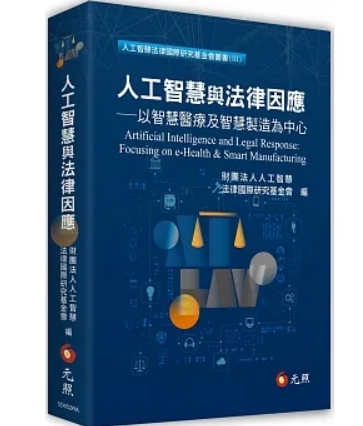
Introduction
This book brings together scholars and experts focused on AI legal issues to share insights on current hot topics, including the legal aspects of smart transportation, smart finance, and smart healthcare. It also explores AI’s intersections with judicial applications, environmental protection, corporate governance, and intellectual property, guiding us forward together in the world of AI!
Content
Executive Director’s Preface / Li-Ching Chan
[Smart Healthcare]
Medizin und Digitalisierung (eHealth) – Eine neue Herausforderung für das Technikrecht / Eric Hilgendorf
Medicine and Digitalization (eHealth) – A New Challenge for Technology Law / by Eric Hilgendorf, translated by Li Ruixiang
Exploring Criminal Liability Risks in AI-Driven Healthcare / Zhang Liqing
Legal Liability in AI Healthcare Applications – Focusing on AI-Assisted Medical Imaging Interpretation / Wu Zhenji
Challenges Faced by Hospital Institutional Review Boards (IRB) in Smart Healthcare / Ge Jin
Ethical Governance and Contractual Models of Medical Data / Li Chongxi
Trading and Protection of Data – Commentary on Ethical Governance and Contractual Models of Medical Resources / Wang Jixuan
Post-Pandemic Telemedicine and Smart Healthcare – Reconstructing Doctor-Patient Relationships and Advancing Innovative Technologies / Wu Junying, Yang Zengwei
Legal Regulation of Mobile Medical Applications (Mobile Medical Apps) on Smart Devices / Liu Hongen
[Smart Manufacturing]
Development of Metal Materials and Smart Manufacturing / Lin Dongyi, Wu Jinglin, Yang Shengmin
Copyright Protection of Artificial Intelligence / Qiu Yixian
Impact of Industry 4.0 on Labor Law and Countermeasures – The Case of Germany’s Working Time Law / Lin Gengsheng
Patentability and Inventive Step of AI Inventions / Zhou Bohan
Human or Not? – Preliminary Exploration of Intellectual Property Protection for AI R&D Outcomes / Chen Longsheng
Legal Issues in Industrial Data Governance / Zhu Chenzo
Verantwortungsdiffusion und selbstlernende Systeme in der Industrie 4.0 – ein Problemaufriss aus strafrechtlicher Perspektive / Eric Hilgendorf
Diffusion of Responsibility and Self-Learning Systems in Industry 4.0 – An Overview from a Criminal Law Perspective / by Eric Hilgendorf, translated by Li Ruixiang, supervised by Chen Junrong
Jidō unten o meguru keiji-hōteki shomondai / Takaki Matsumiya
Criminal Law Issues Regarding Autonomous Driving / by Takaki Matsumiya, translated by Sun Wen
Preface
Executive Director’s Preface
The development of artificial intelligence (AI) has not slowed down due to the COVID-19 pandemic. On the contrary, the pandemic, by changing the way humans work and live—such as remote work and distance learning—has accelerated AI development. In particular, the emergence of generative AI, led by ChatGPT at the end of 2022, has strengthened the connection between AI and humans, making it a focal point for AI development in the post-pandemic era.
Similarly, the publication of our academic monograph series has not paused due to the pandemic. Although AI and Legal Responses—as the third academic monograph of our Foundation—was published after a long interval following the previous monograph due to the pandemic and other factors, we persevered and continued our work during this period, ultimately bringing the book to completion. As one of Taiwan’s key platforms for AI legal research, our Foundation hopes that the continued publication of this academic monograph series will contribute to the advancement of AI-related legal frameworks in Taiwan.
This book primarily compiles papers from the AI and Law International Academic Conferences held by our Foundation in late 2020 in Taipei and Taichung, covering the themes of “Smart Healthcare” and “Smart Manufacturing.” These conferences attracted significant attention from academia, industry, and government. For the Taipei Smart Healthcare session, attendees included Minister without Portfolio Deng Zhenzhong of the Executive Yuan, Minister of Justice Tsai Ching-hsiang, Minister of the Interior Hsu Kuo-yung, Deputy Minister of Health and Welfare Hsieh Jui-yuan, Director Li Fa-yao of Taipei Veterans General Hospital, Legislator Chiu Tai-yuan, Chairman Peng Fang-gu of the Poison and Drug Control Development Foundation, and Chairman Zhou Sheng-ping of Mengjia Qingshuiyan Ancestor Temple. For the Taichung Smart Manufacturing session, attendees included Minister without Portfolio Audrey Tang, Deputy Minister of Justice Chen Ming-tang, Director Lin Ming-ren of the Humanities Division of the Ministry of Science and Technology, Director Hsu Mao-hsin of the Central Taiwan Science Park Administration, President Wang Mao-jun of Tunghai University, President Chen Yue-duan of National Kaohsiung University, Legislator Kao Hung-an, Chairman Liang Jin-li of the Central Taiwan Listed Companies Elite Association, and General Counsel Fang Guang-yu of Foxconn Technology Group, among many other government officials, industry leaders, and societal figures, whose encouragement and support were invaluable.
This book includes nineteen papers (including translated works) presented at the conferences, offering rich insights. The authors are experts well-versed in smart healthcare and smart manufacturing, providing thought-provoking AI legal perspectives and recommendations for legislation or legal reform. International contributions include two major papers by Professor Eric Hilgendorf of the University of Würzburg, Germany, on smart healthcare (Medicine and Digitalization (eHealth) – A New Challenge for Technology Law) and smart manufacturing (Diffusion of Responsibility and Self-Learning Systems in Industry 4.0 – A Criminal Law Perspective). Both were translated by PhD student Li Ruixiang (smart manufacturing supervised by Associate Professor Chen Junrong, National Taiwan Ocean University). These papers provide a German legal perspective for Taiwan to reference. Additionally, Professor Takaki Matsumiya of Ritsumeikan University, Japan, presented Criminal Law Issues Regarding Autonomous Driving (translated by Dr. Sun Wen; interpreted during the conference by lawyer Hong Shixuan), offering insights on civil and criminal liability and emergency protocols related to autonomous driving.
Taiwanese scholars also made significant contributions. In smart healthcare, I explored criminal liability risks in AI-driven healthcare, introducing application domains, features, ethical guidelines, and corresponding legal risks, and proposed strategies to address them. Professor Wu Zhenji (National Taiwan University College of Medicine) analyzed AI-assisted medical imaging interpretation, discussing principles, limitations, and associated legal responsibilities. Dr. Ge Jin (Taipei Veterans General Hospital) discussed challenges faced by hospital Institutional Review Boards (IRB) in smart healthcare, focusing on pharmaceutical development, certification, and industry-academia collaboration.
Professor Li Chongxi (Taipei Medical University, Institute of Medical and Biotechnological Law) addressed ethical governance and contractual models of medical data, exploring privacy protection, data cooperation types, and contract essentials. Associate Professor Wang Jixuan (Chinese Culture University, School of Law) further commented on data trading and protection. Professor Wu Junying (National Yang Ming Chiao Tung University, Institute of Biomedical Informatics) and Postdoctoral Researcher Yang Zengwei (National Health Research Institutes) discussed post-pandemic telemedicine and smart healthcare, focusing on doctor-patient relationships and technological innovation, highlighting legal liability issues—whether responsibility lies with physicians or product manufacturers. Associate Professor Liu Hongen (National Chengchi University, School of Law) examined legal regulation of mobile medical apps on smart devices, a topic increasingly relevant with the widespread use of smart wearables.
In smart manufacturing, Professor Lin Dongyi (National Yang Ming Chiao Tung University, Institute of Traditional Medicine) and research assistants discussed the development of metal materials and their integration with smart manufacturing. Lawyer Qiu Yixian addressed copyright protection for AI creations. Professor Lin Gengsheng (Tunghai University, School of Law) explored labor law implications of Industry 4.0, referencing German working time law and European Court rulings, and proposed countermeasures.
Professor Zhou Bohan (National Kaohsiung University, School of Law) analyzed patentability and inventive step of AI inventions under U.S., European, and Taiwanese law. Associate Professor Chen Longsheng (National Chung Hsing University, Department of Law) examined intellectual property protection for AI R&D outcomes, evaluating the necessity from a Japanese legal perspective, including commentary on Taiwan’s AI Basic Law draft. General Counsel Zhu Chenzo (Sharp, and Secretary General of our Foundation) analyzed legal issues in industrial data governance, including utilization of big data, comparative data regulations, and issues regarding data ownership and monopolization.
This book, as the third in the AI and Law Academic Monograph Series of the Foundation, marks the successful establishment and operation of our research platform. Running the Foundation has been a challenging journey, and I have deeply appreciated participating in its growth. I must especially thank Chairman Xu Zongxian and board members Yang Yinming, Chen Minchun, Qiu Changqi, Chen Zhao, Ye Kuncheng, Zhu Wanjun, Pan Yongfeng, Wu Jianqing, and Chen Zhian for their selfless contributions to the development of AI legal frameworks in Taiwan. I also extend sincere gratitude to the broader community for supporting the Foundation and to Yuan-Zhao Publishing Company for assisting with the publication of this book.
Chang Li-Ching
Executive Director
AI & Law International Research Foundation
Executive Director
AI & Law International Research Foundation

 SSL 256bit transmission encryption mechanism